Energy security through diversified and resilient supply.
First Offshore Wind Energy Project of Sri Lanka (FOWEPSL)
Collaborating with global offshore wind energy innovators, we are working to establish the First Offshore Wind Energy Project of Sri Lanka (FOWEPSL). As an island surrounded by vast open ocean and rich wind resources, Sri Lanka is uniquely positioned to harness offshore wind energy. This initiative aims to strengthen national investment capacity, expand project-development expertise, and build on the country’s rapidly growing local capabilities.
Offshore wind energy must be embraced as a core element of Sri Lanka’s long-term energy strategy, alongside other renewable and conventional sources. Its value extends far beyond power generation, contributing to:
Cost-effective electricity for households and industries.
Local job creation and broad economic growth.
Climate and environmental benefits that support national sustainability goals.
Grid stability, supported by storage, conversion, and balancing technologies.
Foreign investment attraction, positioning Sri Lanka as a regional clean-energy leader.
The initiation of Green Hydrogen production, unlocking new pathways for energy transition and industrial innovation.
Sri Lanka Offshore Wind Roadmap Launched, Two Sites Identified for First Project(s)
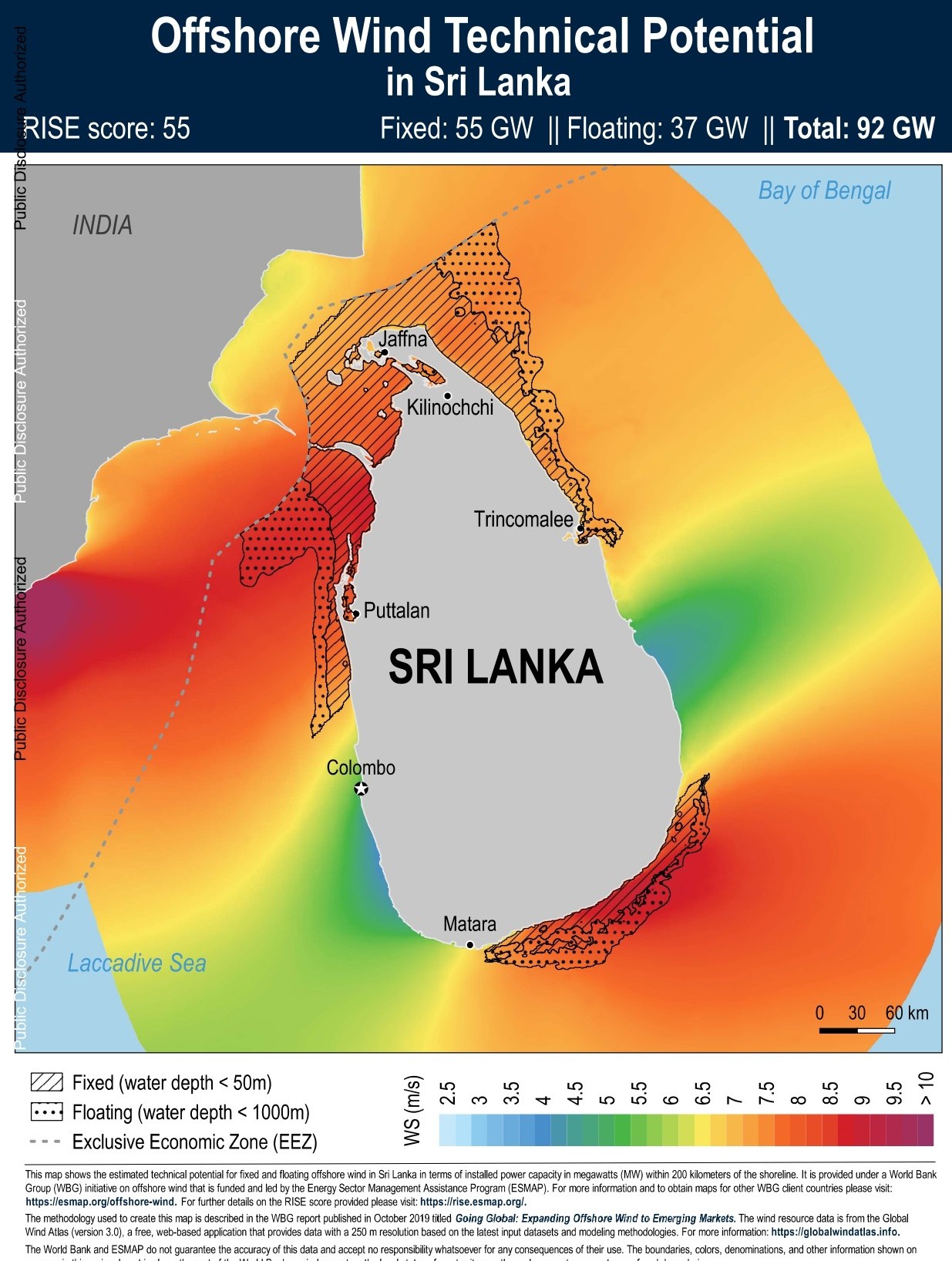
The World Bank Group has published the Offshore Wind Roadmap for Sri Lanka, commissioned by the Government of Sri Lanka and funded by the World Bank Energy Sector Management Assistance Program (ESMAP) and PROBLUE. The roadmap estimates the country’s locational offshore wind potential to be 56 GW and identifies two sites where Sri Lanka could build its first projects.
While the roadmap was being finalised last year, the World Bank already revealed some details about the country’s estimated technical potential and locations, as well as the area(s) considered for Sri Lanka’s first project.
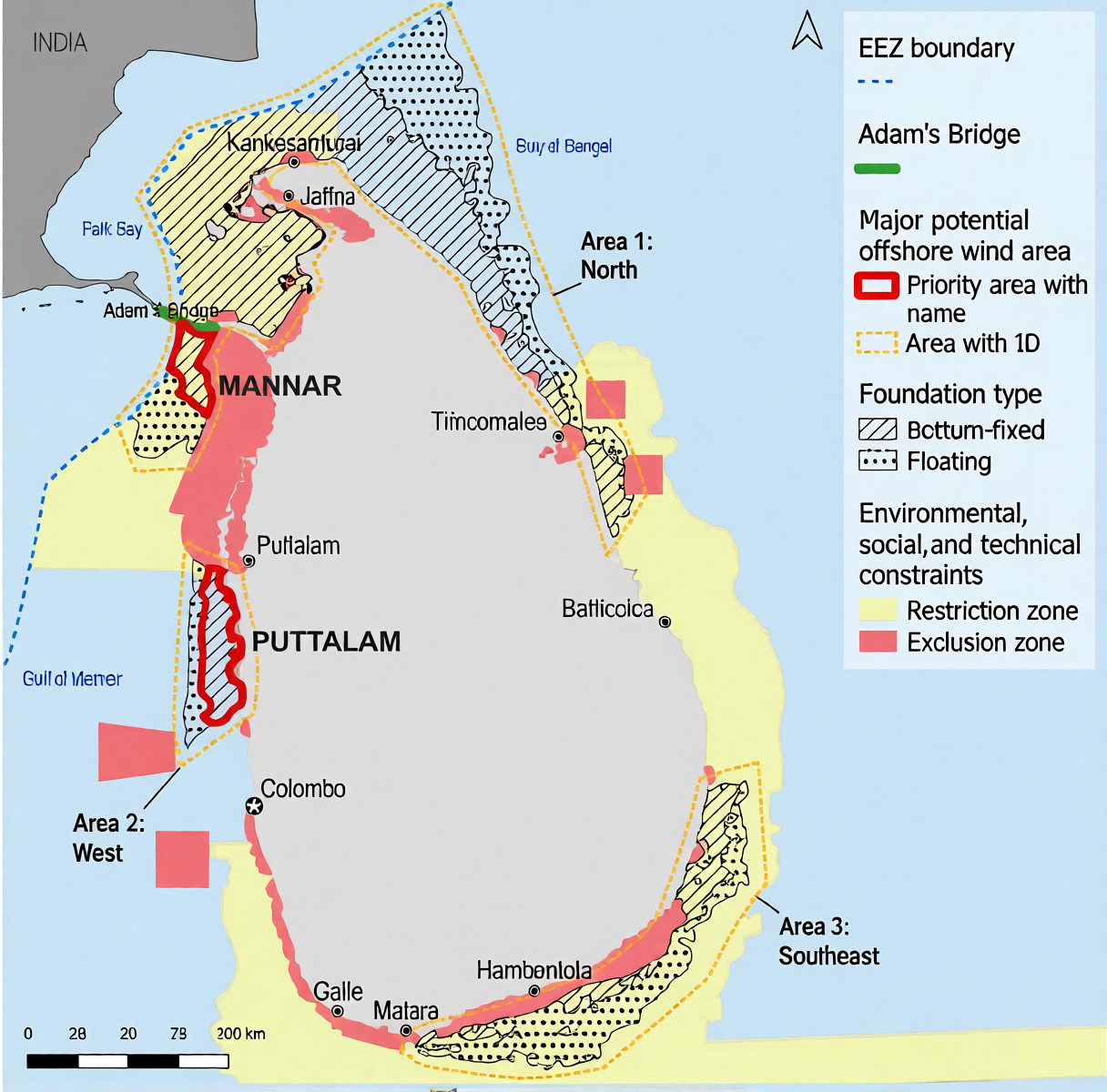
In the final document now issued, the World Bank and ESMAP delineate three broad areas suitable for offshore wind development and note that the western and southern coasts have the most suitable wind speeds and technical conditions.
For the first wind turbines that would be installed in Sri Lankan waters, the roadmap identifies two large areas in the Gulf of Mannar that could be suitable for building the first offshore wind farm(s). The two areas, which are close to Mannar Island and Puttalam, have shallow waters suitable for fixed-bottom foundations and moderate wind speeds averaging 8–9 m/s.
Of the 56 GW of identified locational potential, 27 GW of offshore wind capacity is located in water depths of less than 50 metres, where fixed-bottom technology would be most suitable, and the floating wind potential is estimated to be 29 GW, located across sites in deeper waters of between 50 and 1,000 metres.
Not all of the identified capacity potential will be economically feasible, especially in areas with lower wind speeds and deeper waters, however, even a small portion of the identified potential could provide a significant contribution to Sri Lanka’s energy mix and present a promising new opportunity for the country, according to the roadmap.